Borehole Drilling Cost In Kenya
Grekkon Limited’s borehole drilling cost in Kenya through a mechanical drilling rig is dependent on 2 factors:
-
- The borehole drilling method; air v mud drilling
- Casings type to install; PVC v steel casings
- The geographical drilling location; determines the mobilisation cost
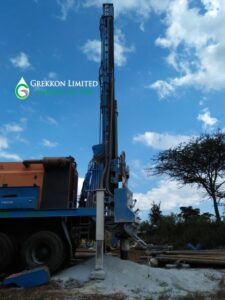
A Grekkon Limited borehole drilling rig on site at Matuu area, Machakos county
The borehole drilling method
There are 2 borehole drilling methods;
I. Air drilling / pneumatic percussion drilling is an under-balanced drilling technique (UBD). Here, compressed air or nitrogen is used to cool the drilling bit and extract the cuttings of a well-bore instead of fluids. this is carried on stable ground with a proper rock formation II. Mud rotary drilling. The fluid is pumped down the hollow drill pipe (kelly) and forced out of jets in the drill bits. It is an open hole reciculatory drilling method. Chemicals used here are; Bentonite clay (Gel), Barium sulphate (Barite), Calcium carbonate (chalk), and Hematite The location. The further it is from our branches, the higher the mobilisation cost
Our borehole drilling price in Kenya varies with the the drilling method, which is determined by the rock structure
Borehole Drilling Price In Kenya
By Drilling Method
| Drilling Method | What it entails | Price in KES Per Meter |
| 1. Air drilling | Drilling on stable ground that has a proper rock formation beneath | KES 6,500 |
| 2. Mud drilling | Drilling on loose ground that has no or minimal rock beneath |
KES 14,050 |
Borehole Drilling Cost in Kenya
Details
| Process | Cost Per Meter- Air drilling method | Cost Per Meter- Mud drilling method | |
| 1 | Mobilisation | KES 420 | KES 420 |
| 2 | Drilling | KES 3,220 | KES 11,270 |
| 3 | Casing | KES 2,269 | KES 2,569 |
| 4 | Graveling | KES 280 | KES 280 |
| 5 | Well development | KES 70 | KES 70 |
| 6 | Test pumping | KES 420 | KES 420 |
| 7 | Water chemical analysis | KES 21 | KES 21 |
| Total | KES 6,700 | KES 15,050 |
- Mobilisation is the movement of human resource and equipment to the borehole drilling site
- Drilling is the actual sinking of the 8″ diameter well in the ground
- Casing is the installation of PVC or metallic 6″ diameter tubes to support the well, keeping it from collapse. Those along the water aquifer are slotted to allow in water into the well. The slots are 1mm to 2mm in size
- Graveling is the application of gravel in the 2″ gap between the well and the casings. Graveling holds the casings in place and also sieves the water
- Well development is the cleaning of the well to remove debris
- Test pumping is the process of pumping out water for 24 hours from the borehole with a large submersible water pump, powered an equally powerful generator. This establishes the water recharge rate (yield of the borehole) given in cubic litres per hour, and the static water level. The test pumping results determine the type of electric or solar submersible water pump install in the well
- Water chemical analysis is the last stage. A sample of water is analysed in the laboratory to determine it’s chemical composition. With these results, a grower assesses the suitability of the water for irrigation for specific crops according to their salt/ salinity tolerance
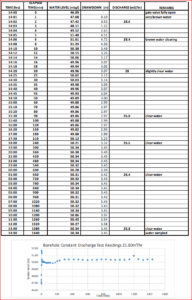
A test pumping report from a borehole drilling service by Grekkon Limited
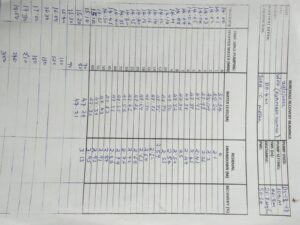
A water analysis report from a newly drilled well
Cost of Drilling A Borehole in Kenya
By Geographical Location
| County | Cost (Min) | Cost (Max) |
| Nairobi | KES 6,500 | KES 9,500 |
| Kajiado | KES 6,500 | KES 9,500 |
| Machakos | KES 6,600 | KES 9,500 |
| Kitui | KES 6,800 | KES 9,500 |
| Makueni | KES 6,700 | KES 9,500 |
| Kiambu | KES 6,500 | KES 9,500 |
| Nakuru | KES 6,800 | KES 9,500 |
| Kisumu | KES 7,500 | KES 9,500 |
| Turkana | KES 8,000 | KES 9,500 |
| Bungoma | KES 6,900 | KES 9,500 |
| Busia | KES 7,700 | KES 9,500 |
| Narok | KES 6,800 | KES 9,500 |
| Mombasa | KES 7,500 | KES 9,500 |
| Kilifi | KES 7,500 | KES 9,500 |
| Kwale | KES 7,600 | KES 9,500 |
| Baringo | KES 6,900 | KES 9,500 |
| Siaya | KES 7,600 | KES 9,500 |
| Homabay | KES 7,600 | KES 9,500 |
| Uasin Gishu | KES 6,900 | KES 9,500 |
How to drill a borehole in Kenya; What the drilling cost entails
-
Mobilisation
This is the transfer to the well site of the rig, equipment, and labor. We cost mobilisation by distance. A borehole project 500kms away from our office will pay more for mobilisation than one that is 50kms away. Mobilisation costs allow for bush clearing and site preparation costs. This is to ready the borehole drilling site for the drilling rig and all other heavy equipment
-
Borehole drilling
This is the actual process of sinking a well in the ground in order to obtain water. The depth of sinking depends on the reading of the hydro-geological survey report. This report states the depth, amount of water expected, and the geological structure of the soil and rock underneath. The common size of the borehole well is 8 inches in diameter, but the surface section is 10 inches. Some wells are larger, going up to 14 inches in diameter
3. Casing
We line the walls of the borehole with mild steel or polyvinyl chloride (uPVC) casings. This is to keep the wall from collapsing throughout the lifetime of the borehole. We install 4mm – 4.5mm thick steel casings where the well has boulders, and where mud drilling is conducted. uPVC casings are installed in wells that lack boulders or that are rich in sand, and the water is highly saline. High salinity causes intense rusting on steel casings over time, hence the preference for uPVC casings in such wells
There are 2 types of casings
3.1. Continuous casings. They line the sections where the aquifer(s) is absent. They serve as water storage units because this is where the water is held. Surface casing are set from the mouth of the well downwards to the point where the walls are stronger. It could be as short as 3M, or as deep as 30M. Surface casings are 8″ in diameter
3.2. Slotted casings. They line the aquifer sections to allow water into the well. The slots are 1mm to 2mm in size
Our installation ratio of continuous and slotted casings is 70:30. This ensures maximum percolation of the water from the aquifer into the borehole

Mild steel casing on the foreground waiting tobe installed during a well development process by Grekkon Limited in Muthuani area, Machakos county
4. Graveling
It is the application of gravel sand between the borehole walls and the mild steel casings. Gravel filters soil and other impurities and keeps the casings firmly in position. Our gravel size is 2mm to 4mm, and well rounded
5. Flushing and capping
The well is cleaned of all chippings, a process referred to as flushing which is done after casing and also after graveling. Where casing is not carried out, flushing is done too. It is the process of pushing water within the well under intense pressure, then releasing it as a jet from the mouth of the well. Flushing allows optimal water flow from the aquifer to the well, and it precedes test pumping. In a high yielding borehole, the water within the well is used to clean it up. Where the well is low in yield, additional water is sourced for externally and added into the well.

Grekkon Limited’s team flushes a low yield in Lukenya area, Machakos county. Notice the use of additional water from a water bowser on the left
After flushing, the well is sealed at the top with a cap to prevent dirt and other material from getting in
6. Test pumping
We draw out borehole water for 24 hours. This shows the yield of the well, recharge rate and water level. It is with this report that we determine the right solar or electric submersible water pump. Before the test pumping process, we determine the most suitable test pumping water pump and the right pipe diameter to use based on the estimated volume of water in the well. Our test pumping pipe diameter sizes are installed as;
| Estimated Borehole Yield | Test Pumping Pipe Diameter |
| 0.5 – 10 cubic litres per hour | 1″ |
| 11 – 25 cubic litres per hour | 1-1/2″ |
| > 25 cubic litres per hour |
2″ |
Having the right test pumping pump and pipe diameter size is key in achieving the right yield of the well
7. Water chemical analysis
Laboratory analysis of the chemical composition of the borehole water
Best Borehole Drilling Company: FAQs
How much is drilling a borehole in Kenya?
As the best borehole drilling company in Kenya, we tailor our price according to the hydro-geological survey result finding
How many meters is a borehole?
From 50M and below, a well qualifies as a borehole
How deep is good borehole?
A good depth one where the most productive aquifers are reached, and with good water qualityWhat is the average depth of a borehole in Kenya?
None. This is by location only because the variances are large.How do you know where to drill a borehole?
Through a hydro-geological survey by an independent hydro-geologist. It determines; water availability at which point, how much water, and at what depth
How many days does it take to drill a borehole?
It depends on the depth and the rock formationHow long does a borehole last?
It lasts in as much as the water table or aquifer remains
What is a good borehole yield?
It depends on water usage. For domestic use, a yield of 2 cubic meters per day is sufficient for a homestead. For farming, a higher yield is better
Can a borehole be drilled anywhere?
No. Only where there is a water aquifer. This is why a hydro-geological survey is conducted to show exactly where the water source is
Can borehole water run out?
Yes it does when the water aquifer dries up
Do I need permission to drill a borehole?
Yes, permission must be sought. 3 certificates and permits are needed in order of priority listed below- Water Resource Management Authority (WARMA) authorisation
- National Environmental Management Authority (NEMA) permit
- County government permit (in counties that demand this)